“After a Night Shift, I Fell Asleep at the Laundromat with My Baby — Opening the Washer Left Me Speechless”
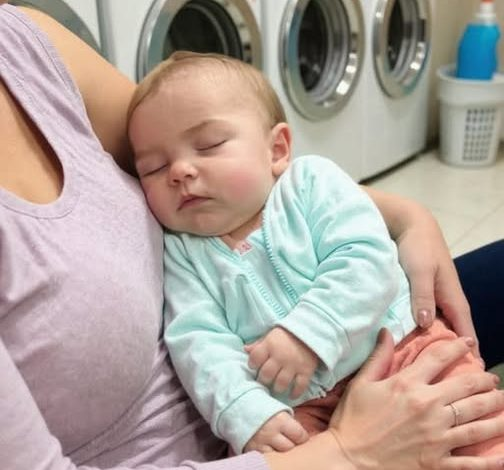
I trudged to the laundromat after a night shift, Willow, my seven-month-old daughter, tucked against me, fast asleep. Fatigue hit like a freight train—I collapsed into a chair while the washer churned. When I blinked awake, my laundry was folded perfectly, but what I saw in the machine made my hands tremble.
I work at a pharmacy, often convincing myself I’m on a “day shift” just to get through the week. Reality is harsher. When coworkers call out or the store runs short, I take every available shift. The extra pay keeps baby formula, diapers, and essentials from sliding into “next week.”
Willow is seven and a half months old, at that magical age where she smells like warm milk and sunlight. Her tiny grin can erase the weight of bills. Her dad left the moment I told him I was pregnant.
“I’m not ready for this,” he said, like fatherhood was a jacket too tight to wear. By month five, I stopped checking my phone for him.
It’s just me, Mom, and Willow against the world. Mom helps when I work, and I tell myself the tightness in my chest is gratitude, not guilt. But she already raised children once. She didn’t sign up for 3 a.m. feedings at 61, yet she does it without complaint.
Our apartment is small, on the second floor of a building that’s seen better days. Rent is manageable, but there’s no washer. Laundry piles up, so I drag it down the street to the laundromat with its blinking neon sign and sticky floors.
That morning, after a long night, I walked in exhausted. My body ached, eyes stinging, and the laundry basket threatened to topple. I sighed.
“Time for the laundromat, baby,” I whispered to Willow, nestled in my arms.
Mom was still asleep, recovering from staying up with Willow while I worked. I didn’t want to disturb her. She needed rest as much as I did.
I bundled Willow in her jacket, stuffed the laundry into a bag, and headed out.
The laundromat smelled of detergent and hums of spinning machines. One woman, maybe in her fifties, removed clothes from a dryer. She looked up and smiled warmly.
“What a sweet little one,” she said.
“Thanks,” I mumbled.
Once she left, it was just me and Willow. I loaded the washer—her onesies, my work shirts, towels, even her little elephant blanket—fed in the quarters, pressed start, and sank into a stiff chair.
Willow fussed a bit. I rocked her, swaying until she dozed again. With nothing clean to cover her, I grabbed a thin blanket from the dirty pile and wrapped her up. Warm and soft, she rested against me, and my head felt heavy.
I told myself I’d just close my eyes for a moment… and I fell asleep.
Sunlight slanted through the windows when I woke. My heart leapt. Willow was safe, but something felt off.
The machines had stopped. Silence filled the room. And on the folding table… my laundry. Neatly folded. Every piece.
Shirts stacked into tidy piles. Onesies sorted by color. Towels arranged like a store display.
Someone had done this while I slept.
Panic surged. What if someone touched Willow? Took something?
But everything was there. She was safe.
Then I saw the washer I’d used. The door was closed. Inside were diapers, wipes, two cans of formula, a soft blanket, and a stuffed elephant. On top lay a folded note:
“For you and your little girl. — J.”
My hands shook as I picked it up. The laundromat was empty. Whoever “J” was, they had vanished.
At home, I spread out the gifts. Mom gasped.
“There are still good people in the world,” she whispered.
I stuck the note on the fridge with a sunflower magnet. Every glance reminded me someone cared.
A week later, after a grueling double shift, a wicker basket sat at our door. Groceries, baby food, oatmeal, bananas, crackers. Another note, same handwriting:
“You’re doing amazing. Keep going. — J.”
I laughed and cried at once, overwhelmed. Who was this person? How did they know exactly what we needed?
That night, after Willow and Mom were asleep, I left my own note under the doormat:
“Thank you. Please let me know who you are. I want to thank you properly.”
Days passed. One morning, I returned home to see a young man near the gate, shifting nervously.
“Harper?” he said softly.
“Wait… Jaxon?” I asked.
He nodded. It clicked. Jaxon—the quiet kid from English class, the one everyone bullied. I was the only one who had stood up for him.
“I wanted to help you,” he said. “You defended me when no one else did. I never forgot. Now it’s my turn.”
Tears ran down my cheeks. Words weren’t enough.
Jaxon began visiting occasionally—bringing diapers, groceries, fixing little things. He never asked for anything in return. Mom started calling him “Uncle J.” No romance—just steady, quiet friendship.
Months later, my boss gave me steady hours and a raise, saying someone had recommended me for being an incredible worker. He didn’t reveal who. I didn’t need him to.
I looked at the faded note on the fridge:
“For you and your little girl. — J.”
I smiled through tears. Sometimes, kindness given years ago returns in ways you never expect. Jaxon didn’t just provide food or help with laundry—he reminded me that quiet goodness exists, waiting for the right moment to show itself.