My Neighbor Kept Piling Snow onto Our Driveway—So I Gave Him a Lesson He Won’t Forget
Being a single mom is already a full-time endurance test. Long hours, little rest, and the weight of every decision landing on your shoulders. Add conflict you never asked for—and the exhaustion settles in deeper than you realize, until one moment finally pushes you too far.
My name is Laura. I’m 39, a trauma nurse, and tired in a way sleep can’t fix. My shifts stretch twelve to fourteen hours, beginning before daylight and ending long after dark. When I get home, my feet ache, my mind buzzes, and I’m running on fumes.
It’s just me and my son, Evan. He’s twelve. His father hasn’t been part of our lives for years. That used to terrify me—but somewhere along the way, Evan and I found our balance. We became our own little team.
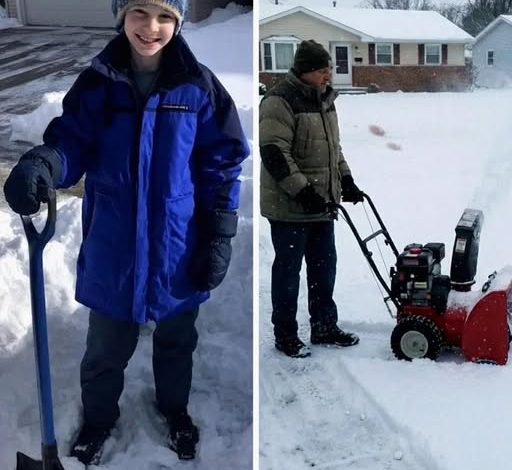
Evan rarely complains. In fact, he does more than he should. He insists on helping—washing dishes, folding clothes, and during winter, shoveling the driveway after school so I can pull in safely when I come home late, still in damp scrubs.
He says it makes him feel helpful. I tell him he’s my hero.
That winter was relentless. Heavy snow fell again and again, thick enough to double overnight. Some weekends, we bundled up together and tackled it side by side, laughing between shovelfuls, breath turning to fog in the cold air. I bribed him with hot cocoa. He pretended he didn’t care—then drank every drop.
Across the street lived Mark. The kind of neighbor who smiled only when it benefited him. His lawn was always pristine, his driveway spotless. He waved if you waved first. We’d lived across from each other for two years and barely exchanged more than polite nods.
That winter, Mark bought a snowblower.
The first morning he used it, he looked ridiculously proud—ski goggles, thick gloves, chest puffed out like he was conquering a mountain instead of suburban snow. I actually felt relieved. Maybe this winter won’t be so bad, I told Evan.
I was wrong.
Every snowfall followed the same pattern. Mark cleared his driveway early—and every time, a wall of snow ended up shoved straight across ours.
The first time, I assumed it was a mistake. The second, careless. By the third, it was intentional. And every time, Evan cleaned it up.
He never said a word.
One night after a brutal shift—three trauma cases back-to-back, one of them fatal—I pulled onto our street and saw Evan outside under the porch light, pushing heavy snow with exhausted arms. Something inside me broke.
He greeted me with a tired smile. Dinner—grilled cheese—was waiting in the microwave. My twelve-year-old was carrying burdens no child should.
The next day, I finally confronted Mark.
He was outside again, snowblower roaring. I waited until he shut it off.
“Oh hey, Laura,” he said casually.
I explained calmly that the snow from his driveway was ending up on ours—and that my son was shoveling it so I could get home safely.
He laughed. “What’s the problem? It’s snow. That’s just how it blows. It’ll melt.”
I tried once more. He shrugged. “It’s winter,” then turned the machine back on—and sent another pile straight across our driveway.
That was the last conversation we had.
A few evenings later, I came home early and found Evan struggling with yet another mound of snow. His face was red, his movements slow. I hugged him and told him to stop.
“But you won’t be able to park later,” he said, worried.
“I’ll handle it,” I told him. “You don’t have to fix something that isn’t your fault.”
That night, I stopped reacting—and started documenting.
I read the HOA rules. I took photos. I logged dates and times. I saved doorbell footage showing Mark repeatedly dumping snow onto our driveway.
The next snowfall came right on schedule.
Evan asked if he should shovel. I said no.
That evening, Mark did it again.
I filed the complaint.
The next morning, two HOA representatives arrived at Mark’s house. I watched from my kitchen window as his confident posture vanished. They walked him over to our driveway. The evidence spoke for itself.
He was fined. And ordered to clear our driveway immediately.
And he did—slowly, quietly, and completely. For the first time all winter, our driveway was spotless.
Evan watched from the window, cocoa in hand.
“So… it’s over?” he asked.
“It’s over,” I said.
From that day on, Mark never pushed snow onto our driveway again. He never apologized—but he didn’t have to. His behavior changed, and that was enough. Evan officially retired from his unpaid second job, and every snowfall after that was only our own responsibility.
Standing up for yourself doesn’t always mean raising your voice. Sometimes it means knowing the rules, keeping records, and refusing to absorb someone else’s disrespect.
Quiet isn’t weakness.
And being exhausted doesn’t mean you deserve to be walked over.