The Riddle of the 6 Eggs — Solved!
Brain teasers and logic puzzles are a great way to keep your thinking sharp. One puzzle that’s been making the rounds on social media is the “6 Eggs Riddle.” At first glance, it seems like a basic math problem, but it’s really meant to challenge your logic and attention to detail.
The riddle goes like this:
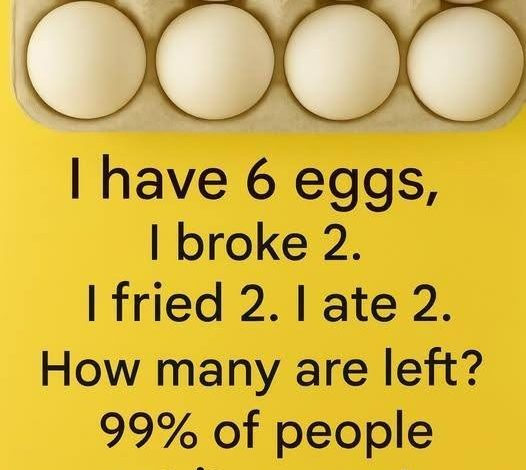
“I have 6 eggs. I broke 2, fried 2, and ate 2. How many eggs are left?”
A lot of people quickly answer “zero,” but that’s not correct. The real answer is 4—and here’s why.
Understanding the Logic
To solve it properly, you need to focus on how the actions relate to each other rather than just adding numbers. The key is realizing that the same eggs are being used throughout the process.
1. Starting Amount
You begin with 6 eggs in total.
2. What Happens to the Eggs
The riddle describes three actions:
- Breaking 2 eggs
- Frying 2 eggs
- Eating 2 eggs
These steps are all performed on the same two eggs, not on separate sets.
3. The Sequence Matters
You crack 2 eggs, cook those same eggs, and then eat them. It’s a single sequence involving the same pair—not three different groups of eggs.
Why People Get It Wrong
Many people instinctively think:
“2 + 2 + 2 = 6, so there must be 0 eggs left.”
But that assumes different eggs were used for each step. In reality, the same 2 eggs are broken, cooked, and eaten.
Looking at the Possible Answers
- “0” is incorrect because it assumes all 6 eggs were used separately.
- “2” overlooks the eggs that were never touched.
- “4” is correct because only 2 out of the 6 eggs were used, leaving 4 untouched.
The Takeaway
This riddle shows how important careful reading is. It’s less about math and more about understanding context. Just like saying, “I bought a steak, cooked it, and ate it,” clearly refers to one steak—not three.
Next time you face a tricky question:
- Read it slowly
- Pay attention to how actions connect
- Don’t rush into calculations