“No Disrespect Grandma, But Let Him Be”
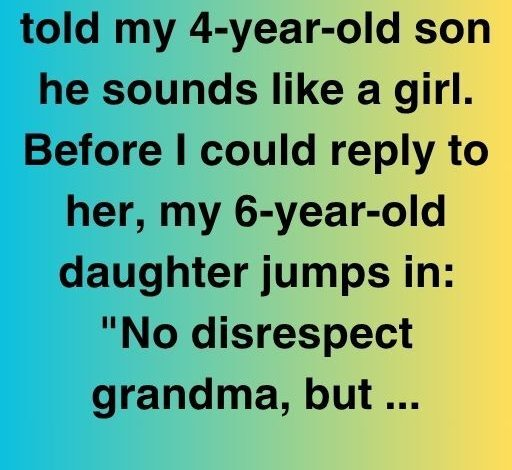
The air in the dining room suddenly went still. My mother-in-law had just told my four-year-old son, Eli, that his voice “sounds like a girl.” Before I could respond, my six-year-old daughter, Mira, looked up from her plate and calmly said, “No offense, Grandma, but boys can sound however they want.”
Everyone paused. We were halfway through our usual Sunday family lunch, and Mira’s quiet, confident comment had stunned the room. Eli, who had been animatedly telling a story moments before, had gone silent, poking at his mashed potatoes. My mother-in-law blinked, clearly surprised at being challenged by a child. She gave a quick, dismissive laugh and said she only meant Eli had a “sweet voice.”
Mira didn’t let it go. “Sweet doesn’t mean girl,” she said with conviction.
I wanted to hug her right there. Mira had always had a strong sense of justice. My husband shifted in his seat, visibly uncomfortable—he’s always been cautious about confronting his mom. I gently tried to defuse the situation by saying how important it is to let kids be themselves. My mother-in-law nodded, but her tight-lipped smile said otherwise.
The rest of lunch was quiet. Mira leaned over to whisper to Eli about dinosaurs, trying to cheer him up.
Later that evening, after the kids were asleep, my husband and I sat on the couch. He defended his mom at first, saying she didn’t mean any harm. I told him that didn’t make it okay. Eli was sensitive, and at his age, every comment sticks. He listened, then admitted I was right. He promised to talk to her. I appreciated that—but I also knew that for her, growth would take time.
Over the next few days, Eli changed. He wasn’t his usual talkative self. His silly voices, the goofy songs during bathtime, the characters he’d create while playing—all of it faded. He became quieter, more cautious. One night, Mira said to me, “He stopped doing his voices. I think Grandma made him sad.”
The next morning, I sat next to him and told him how much I missed his “tiger voice.” He looked down and said, “But Grandma said I sound like a girl.” I pulled him into a hug and said, “You sound like you. That’s what matters.” He didn’t say much, but he leaned against me a little longer than usual.
I couldn’t let it go. That night, I called my mother-in-law. I explained that her comment had really impacted Eli, and that even though she didn’t mean it harshly, he took it to heart. I asked her to talk to him—to help undo some of the harm. She agreed, sounding remorseful.
She came over the next day with a tin of cookies and knelt down in front of Eli. She told him she was sorry and that she thought his voice was amazing, that he was amazing. Eli hesitated, then gave her a small smile. That night, I heard him doing his lion voice again while brushing his teeth. A small victory.
A few weeks later, another challenge came up. Some kids at school teased Eli for wearing his sparkly pink sneakers. My husband suggested we get him a different pair to avoid the teasing, but I knew we couldn’t do that. Changing his shoes meant telling him to hide who he was. I said we had to support him. My husband eventually nodded, understanding.
The next day, Eli wore his pink sneakers again. I watched from a distance at school pickup. A group of boys laughed, pointing at his shoes. My heart sank—until one of them walked over and asked Eli about the lights on his sneakers. They started playing tag, pink shoes and blue shoes flashing across the playground. When Eli climbed into the car, he said, “Josh thinks my shoes are cool.”
The following weeks brought more small wins. The school librarian read a book about being different. More kids showed up with colorful shoes. And then Eli said he wanted to be in the spring talent show. He wanted to do animal voices.
I was nervous, but we supported him. Mira helped him choose his characters, and my husband practiced clapping like a proud fan.
The night of the show, Eli took the stage in a homemade animal mask and those same sparkly pink shoes. He did his voices—roaring like a lion, squeaking like a mouse, and ended with a silly chicken dance that had the audience roaring with laughter. I looked over and saw my mother-in-law on her feet, dabbing tears from her eyes.
When he came off stage, Eli ran straight to me. “Did I do good?” he asked. I told him he was incredible. He grinned, and I knew he believed it.
As we walked to the car, my husband looked at me and said, “I’m glad we let him wear the shoes.” Mira, wise beyond her years, added, “People just need time to learn.”
She’s right. The world may not always understand at first, but that doesn’t mean we should ask our kids to dim their light. There will always be people who say hurtful things without meaning to—but there will also be people who stand up, speak up, and say, “Let them be.”
And those voices? They’re the ones that change the world.
So teach your kids kindness, yes. But also teach them courage. Remind them that being themselves is not just okay—it’s powerful. One brave little voice can make all the difference.