“Found this sticky gunk under a shelf inside my house. What is this?”
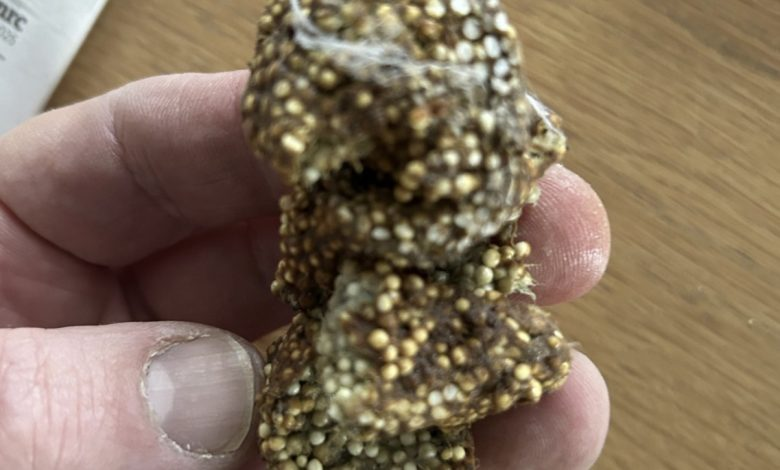
It all began with a very ordinary mission. I was trying to retrieve a stray LEGO piece that had slipped into the shadowy space beneath the bookshelf—an area of the house that might as well be classified as “lost civilization territory.” Armed with a pencil (my standard tool for unknown floor hazards), I prepared for the usual risk: the sharp, unmistakable pain of stepping on a forgotten brick.
But when I reached into the darkness, the pencil didn’t tap plastic. Instead, it pressed into something oddly resistant—lumpy, slightly crunchy, and faintly synthetic. For a brief moment, my imagination went straight to the worst conclusion. I found myself silently hoping, almost pleading: “Please don’t be a mouse. Please don’t be a mouse.”
I nudged it again. Still no movement. No smell of decay, no signs of anything alive—just a strange, nostalgic sort of texture that didn’t belong to anything I could immediately place. Then it clicked.
It was Floam.
A Trip Down Memory Lane: What Floam Was
For anyone who never encountered it, Floam was a late-1990s phenomenon, famously tied to Nickelodeon’s era of gloriously messy toys. It was neon-colored foam-bead putty—soft, moldable, and packed with tiny beads that gave it a distinct crunchy texture.
You could shape it into anything your imagination allowed, or press it into surfaces just for the oddly satisfying crumble it left behind. It lived somewhere between slime, modeling clay, and packing material, but with far more personality and far less dignity.
For many kids, it was irresistible. Commercials alone were enough to create obsession. The day it finally showed up at home felt like unlocking a new category of play entirely—limitless, slightly chaotic, and absolutely unnecessary in the best way.
Unearthing an Old Relic
The version I pulled from under the shelf in 2025 didn’t look like it had aged gracefully. Whatever color it once was had faded into something muted and uncertain—somewhere between dusty pink and “forgotten experiment.”
The texture had changed too. It had become a strange hybrid of hardened foam, dried gum, and something vaguely like stale bread. Yet the tiny beads were still there, stubbornly intact, like they had refused to abandon their post.
I held it up with a kind of dramatic reverence.
“Behold,” I said to my kid, “the Floam of the ancient era.”
The response was less awe and more confusion.
“Why is it crunchy?” they asked.
A fair question.
For a moment, I even reconsidered my life choices. There was a brief, irrational suspicion that I had uncovered something far less innocent than childhood nostalgia. But then the memories came flooding back—Saturday mornings, cartoon commercials, and the intense satisfaction of making something purely for the sake of making it.
This wasn’t a mystery object. It was history.
The Nostalgia That Followed
Something shifted after that. The initial weirdness gave way to something softer. That odd little lump wasn’t just plastic decay—it was a compressed archive of childhood energy.
I could almost hear the old cartoons in the background, the hum of a TV on a Saturday morning, and the sound of Gak doing its unmistakable squish. It was a reminder of a time when creativity didn’t need purpose or productivity. It just happened.
My kid, of course, doesn’t live in that world. Their childhood has different textures—screens, apps, structured everything. And that’s fine. But holding that strange relic made the contrast feel real in a quiet way, like two eras briefly overlapping in the same room.
The Decision
The question was whether to keep it. I didn’t.
It survived about a minute in my hand—long enough to be shown to another adult, who immediately asked if I was seriously considering keeping it in a display case. I wasn’t. Probably.
It went into the trash shortly after.
Not everything from the past needs to be preserved physically to matter. Some things exist just long enough to remind you of where you came from, then they’re allowed to disappear again.
What It Really Meant
Floam was never really about the product itself. It was about the act of playing without intention. No goals, no outcomes, no performance—just hands and imagination and mess.
Finding it again, years later, felt like stumbling across a small reminder of that version of life. Not better or worse, just lighter in a way that’s hard to recreate on purpose.
And maybe that’s the real takeaway. Sometimes the past doesn’t come back as something meaningful or clean or sentimental. Sometimes it comes back as a crumbly, forgotten object under a shelf—just to remind you, briefly, what it felt like to create something for no reason at all.