Can you figure it out in one try with no second guesses?
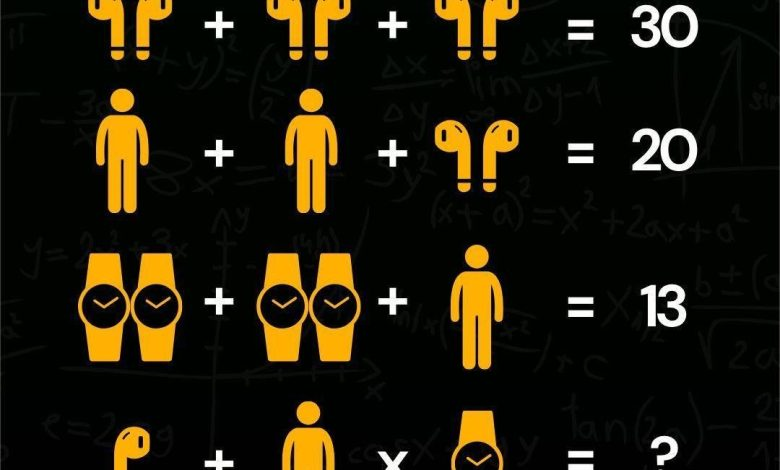
Take a close look at the puzzle. You only get one chance—no changing your answer afterward. At first, it seems like a simple math challenge with a few pictures and easy equations. But the real difficulty is not the arithmetic itself. The puzzle is designed to test whether you notice small visual differences and follow the rules carefully instead of rushing through it.
Understanding the Pattern
Step 1: The First Equation
The first row shows three identical pairs of earbuds adding up to 30. Dividing 30 by 3 tells us that each pair of earbuds is worth 10.
Step 2: The Second Equation
Next, two people plus one pair of earbuds equal 20. Since the earbuds are worth 10, subtracting them leaves 10 for the two people combined. That means each person is worth 5.
Step 3: The Third Equation
Now we see two pairs of watches plus one person totaling 13. Since the person equals 5, subtracting that leaves 8 for the two watch pairs. Therefore, each pair of watches is worth 4, meaning a single watch is worth 2.
The Final Equation
This is where most mistakes happen.
The final line is:
Single earbud + Person × Single watch
But the images are slightly different from the earlier equations:
- The earbuds are no longer a pair—just one earbud, so the value becomes 5 instead of 10
- The person remains worth 5
- The watches are shown as a single watch, worth 2 instead of 4
Substituting the correct values gives:
5 + 5 × 2
Solving Correctly
Using the proper order of operations, multiplication comes before addition.
- First: 5 × 2 = 10
- Then: 5 + 10 = 15
Final Answer: 15
Why So Many People Miss It
The puzzle is less about difficult math and more about careful observation. Common mistakes usually happen because:
- People assume a single object has the same value as a pair
- Small visual changes are overlooked
- The order of operations is ignored
The Bigger Lesson
Challenges like this are really tests of attention and discipline. The trap is not complexity—it’s confidence. Many people stop paying attention once something looks familiar.
The puzzle rewards patience, careful observation, and logical thinking rather than speed. In the end, the real challenge was never just solving the equation. It was noticing whether the details had changed before making assumptions.