Found thousands of these translucent blue, plastic-looking ovals washed up on the beach today. They have a stiff fin on top and blue jelly underneath. Are they dangerous?
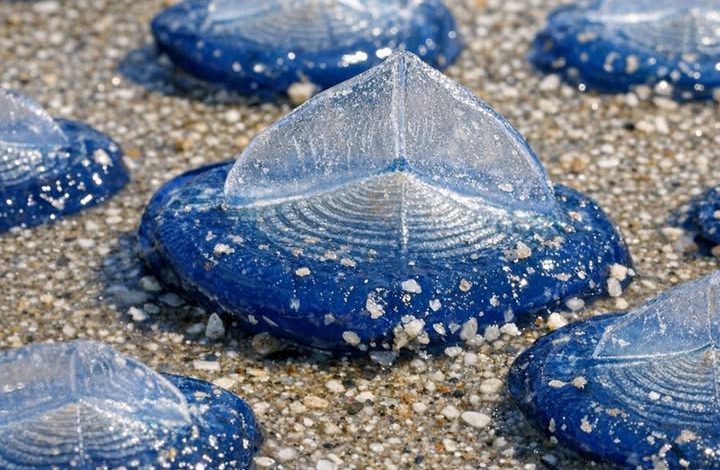
If you’ve recently been walking along the shoreline and noticed thousands of small, blue, plastic-like shapes scattered across the sand, you’re not alone. These unusual objects are actually living marine creatures that sometimes wash ashore in large numbers. Although their appearance can be surprising, they are a natural part of ocean life.
What are these blue shapes?
These organisms are called “By-the-Wind Sailors,” scientifically known as Velella velella. Despite looking like a single animal, each one is actually a floating colony made up of many tiny organisms working together.
They have a flat, bluish body with a small, transparent ridge on top that functions like a sail. Living on the ocean surface, they depend entirely on wind currents for movement. When persistent winds push toward land, large groups can end up stranded along the shoreline.
Are they harmful to touch?
In most cases, they are not dangerous to humans. They contain small stinging cells used to catch microscopic prey, but these are generally too weak to affect people.
Still, caution is advised:
- Sensitive skin may experience mild irritation or tingling
- Avoid touching your eyes or mouth after handling beach organisms
- Pets or small children should not eat them, as it may cause mild stomach upset
How to distinguish them from the Portuguese Man o’ War
People often confuse Velella velella with the more dangerous Portuguese Man o’ War, but there are clear differences:
- Size: By-the-Wind Sailors are small (around 6–7 cm), while Man o’ War can be much larger and more inflated in appearance
- Tentacles: Sailors have short, soft, hair-like structures underneath; Man o’ War have long, trailing tentacles
- Sting: Sailors are mostly harmless; Man o’ War can deliver a painful sting requiring medical attention
Why do they wash up in large numbers?
This phenomenon is known as a mass stranding. It occurs when steady winds push surface-drifting colonies toward the coast. Since they cannot swim or redirect themselves, they become trapped onshore.
These events often happen in spring or summer. While they may seem unusual, they are completely natural. Once stranded, they become food for shorebirds and other wildlife before drying out and fading into translucent remains that can resemble plastic debris.
What should you do if you see them?
If you come across them on the beach:
- Observe them, but avoid disturbing them unnecessarily
- Do not attempt to return them to the water, as they are usually no longer viable
- Keep pets away to prevent accidental ingestion
Seeing large numbers of By-the-Wind Sailors is a reminder of the ocean’s complexity and constant movement. With simple respect and observation, they offer a fascinating glimpse into marine life and natural ocean cycles.